Tofu and tempeh are familiar to many travelers, but in a Balinese kitchen they are much more than convenient alternatives to meat. Each responds differently to heat, moisture, and a freshly cooked spice paste. If you want a satisfying plant-based meal, it is worth learning those differences before collecting a long list of dishes.
For a wider look at sauces, vegetables, and menu planning, start with the vegetarian and vegan Balinese cooking guide. This article stays with the protein-rich ingredients themselves: what they do in a dish, how to cook them, and what to ask when booking a class.
Tempeh: build flavour without losing the bite
Tempeh is made from fermented soybeans held together in a firm cake. Sliced thinly, it browns quickly and develops crisp edges; cut thicker, it stays more substantial inside. That makes it useful in dishes where the seasoning is a glaze or coating rather than a long braise. A sweet-savoury glaze, for example, will cling more effectively after surface moisture has evaporated.
One useful exercise is to cook a small piece lightly and a second piece until more deeply browned, then taste both with the same seasoning. Guests learn why timing matters instead of being told simply to “fry the tempeh.” Check the actual ingredients in bottled sweet soy sauces and pastes when preparing vegan or allergen-aware versions.
Tofu: choose the texture for the method
Firm tofu can be cubed and browned before meeting a spice paste. Softer tofu is better handled gently in a soup or moist sauce, where aggressive stirring would break it apart. Pressing may help a firm, water-packed product brown, but it is not an automatic rule for every tofu sold in Bali or abroad.
Ask to see the tofu before it is cooked: how wet it feels, whether it needs draining, and how much movement it will tolerate in the pan. When selecting tofu and tempeh at a Balinese market, note the texture and appearance so you can choose an equivalent when shopping at home.
Beans and lentils can support a meal, but not every dish
Beans, peas, and lentils may add substance to plant-based meals, especially when tofu or tempeh is unavailable. They are not necessarily substitutes for the same cooking technique, however. A cooked lentil will not hold its shape on a skewer like a slice of tempeh. A soft bean may be more at home in a warm side dish or soup than in a quick, crisp stir-fry.
Some legumes need soaking and thorough cooking before they are ready to serve. In a short class, ask which steps were completed in advance and which you will practise yourself. The learning objective can be understanding a method, rather than pretending every preparatory step fits inside the class time.
Nuts and seeds are usually accents, not an automatic main protein
Peanuts, sesame, and other seeds can bring crunch, richness, and flavour to sauces and garnishes, but their presence alone does not make a plate filling. A dish of rice, vegetables, tofu or tempeh, and a modest sauce makes a more coherent meal than treating garnish as the main component. Guests with allergies must also check these ingredients explicitly; “plant-based” does not mean allergen-free.
How a spice paste changes the ingredient
Balinese flavour often depends on when the paste is cooked and when the protein joins it. A wet paste needs time in the pan to lose its raw aroma. If already-crisp tempeh enters too early, it may soften before serving. Tofu in a simmered sauce has the opposite advantage: it can absorb some of the seasoning while staying moist. Taste the sauce on its own before judging the finished protein.
For an ubud cooking class, ask whether participants fry, simmer, grill, or season their own portion, rather than simply receiving prepared components. Those small steps teach more than a longer menu in which guests only watch.
Putting a protein-rich Balinese plate together
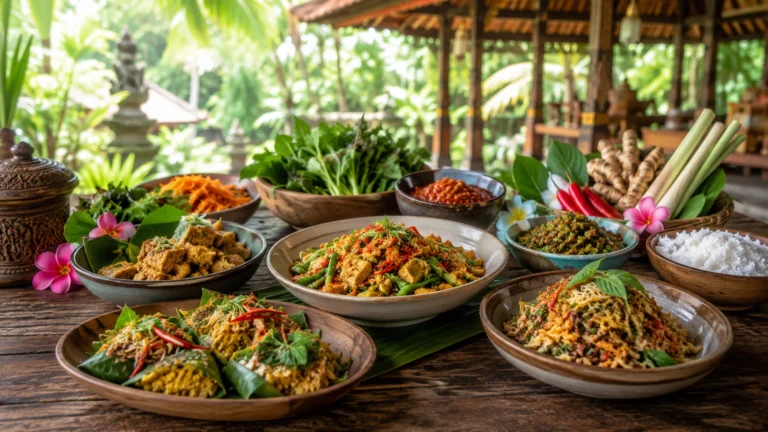
Picture steamed rice with crisp spiced tempeh, a portion of vegetables with grated coconut, a fresh vegetable side, and sambal served separately. The crisp, soft, fresh, and spicy elements have different jobs. There is no need to claim a precise protein total without measuring ingredients and portions, and no reason to assume every vegetarian traveler wants the same amount of food.
For guests arranging a lesson, three practical questions are enough to begin: Which protein will we actually cook? What preparation is done before we arrive? Can a guest avoid or replace ingredients that conflict with their own dietary requirements? The answers should shape the menu before shopping begins.
Bottom line: the best plant-based protein for a Balinese-style dish is the one whose texture suits the method and whose ingredients suit the person eating it. Learning to brown tempeh and handle tofu carefully gives travelers skills they can use well beyond one Ubud meal.