Balinese desserts are often modest in appearance but remarkably precise in the way they balance texture, aroma, sweetness, and freshness. Rice flour can become a tender cake or a chewy dumpling. Palm sugar may hide as a liquid center, dissolve into a glossy sauce, or deepen a slow-cooked pudding. Coconut can be grated, simmered into milk, cooked into a filling, or used as a clean contrast to sticky dough.
For travelers, tasting these sweets is enjoyable; learning how they are made reveals much more. A carefully guided ubud cooking class can show why the same small group of ingredients produces very different results. This guide introduces the major dessert styles, explains their essential ingredients, and places them within markets, family hospitality, and cultural settings without treating every village or household as identical.
What Makes Balinese Desserts Distinctive
Many traditional sweets depend on rice, sticky rice, rice flour, banana, coconut, pandan, and palm sugar rather than butter, cream, or wheat flour. The result is a dessert vocabulary built around chewiness, softness, stickiness, gentle richness, and fragrant sweetness. Portions are often small, which encourages contrast: a tender cake may receive coarse coconut, while a dark rice pudding may be brightened by pale coconut milk.
Sweetness is usually only one part of the experience. Salt in the coconut, earthy rice, lightly bitter caramel notes, grassy pandan, and the natural acidity of fruit keep the food from tasting flat. The most satisfying versions do not simply add more sugar; they control moisture and texture so each component has a clear purpose.
The Ingredient System Behind Traditional Sweets
A useful starting point is the Ubud market ingredient guide, because dessert quality is closely tied to fresh coconut, suitable bananas, aromatic leaves, and palm sugar with a clean flavor. Rice flour provides structure, glutinous rice flour creates elasticity, and whole black sticky rice develops a dense, spoonable texture after slow cooking.
Coconut appears in several forms. Freshly grated flesh creates a dry, fragrant coating; cooked grated coconut becomes a filling; coconut milk enriches sauces and puddings; and a small amount of salt makes its flavor more vivid. Pandan contributes aroma and sometimes color, while banana leaves may support steaming, wrapping, or presentation. None of these ingredients performs only one role.
Six Balinese Sweets Worth Understanding
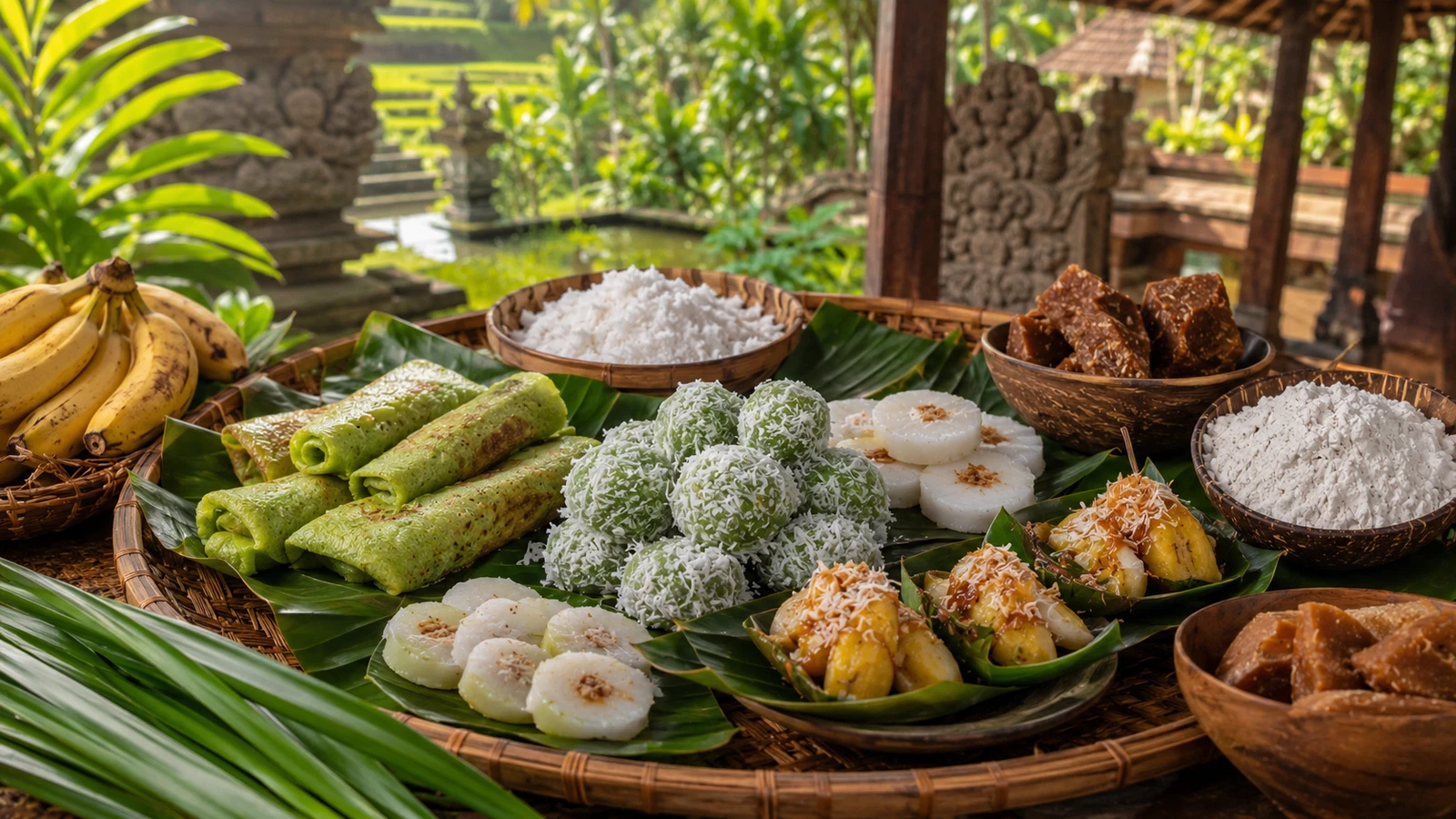
The best-known examples demonstrate different techniques. klepon encloses palm sugar inside chewy rice dough before being boiled and coated in coconut. dadar gulung uses a thin pandan crepe to hold a moist coconut filling. laklak is cooked as small rice-flour cakes and finished with coconut and syrup.
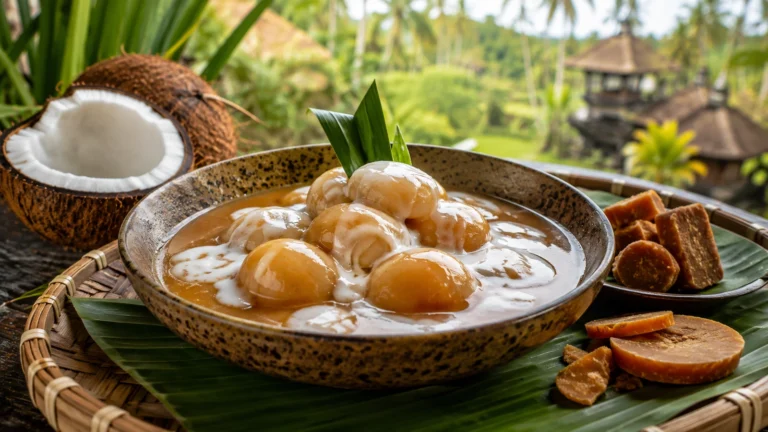
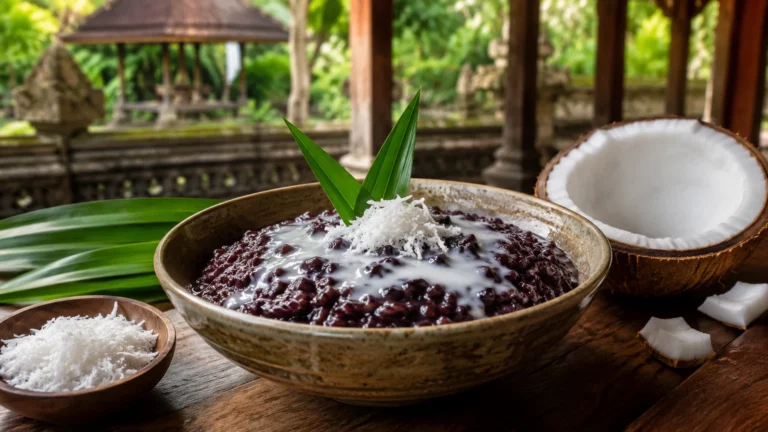
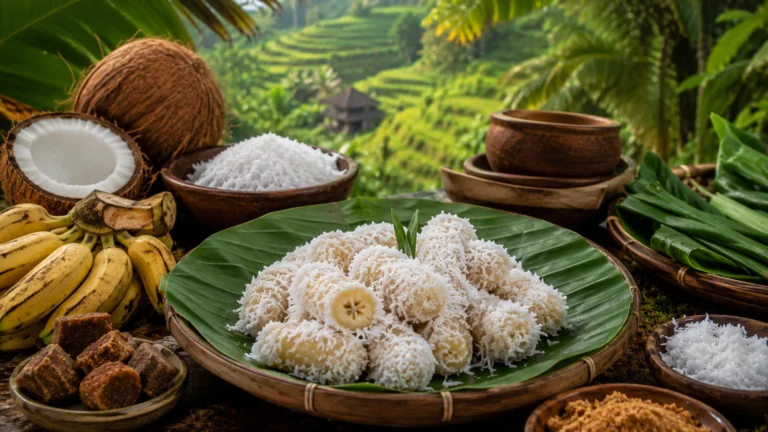
Banana becomes the center of pisang rai, while bubur injin depends on slow-cooked black sticky rice and coconut milk. jaja batun bedil turns rice dough into small chewy dumplings served in a palm sugar and coconut sauce. Together, these sweets show that Balinese dessert making is not one method repeated with different names.
How Palm Sugar Changes More Than Sweetness
The role of palm sugar in Balinese desserts is broader than replacing white sugar. It contributes caramel, smoke, fruit-like depth, moisture, and color. A firm piece can become a melting center, grated sugar can dissolve into filling, and a strained syrup can coat rice cakes. The cook must decide whether the sugar should remain hidden, become integrated, or stay visible as a sauce.
Palm sugar also demands attention because batches vary in moisture and intensity. A dark, soft sugar may melt quickly and taste strong, while a drier block can require more liquid and time. Good cooks adjust by tasting and watching consistency rather than relying only on a fixed spoon measurement.
Pandan and Coconut as Aroma and Texture
Fresh pandan in Balinese sweets offers a soft leafy fragrance that supports rice and coconut without overpowering them. Leaves may be knotted and infused, blended with liquid and strained, or used more subtly as an aromatic background. Bright green color is not the only sign of pandan; aroma is often more important than intensity.
The many uses of fresh coconut in traditional desserts explain why the ingredient appears so frequently. Grated coconut adds texture, coconut milk creates body, and cooked coconut filling carries palm sugar and pandan. Freshness matters because coconut can lose its clean aroma quickly, especially after grating.
Texture Is the Main Technical Challenge
Traditional dessert recipes can look short because the ingredient lists are familiar, yet texture depends on small decisions. Too much flour can make a banana coating heavy. Too little liquid can crack a rice dumpling. A crepe cooked too long becomes difficult to roll, while a rice pudding rushed over high heat may be soft outside and firm inside. Understanding hydration is more useful than memorizing a single ratio.
Heat control is equally important. Boiling dough needs enough movement to cook evenly without tearing it. A crepe pan should set batter before it browns heavily. Palm sugar syrup must dissolve and slightly thicken without becoming candy. Coconut milk should be heated gently so its richness stays smooth. These signs are easier to learn through observation than through a timer alone.
Where Travelers Encounter Balinese Sweets
Traditional markets are one of the most accessible places to see variety. Morning vendors may offer small packets or trays of rice cakes, banana sweets, coconut-filled rolls, and sticky rice. Availability changes with the vendor, day, local demand, and preparation schedule, so a market visit is best treated as discovery rather than a guaranteed checklist.
A Balinese sweet-making class provides a different experience. Instead of only tasting the final food, participants can feel dough consistency, compare palm sugar forms, grate coconut, recognize pandan aroma, and see how quickly textures change during cooking. That practical sequence makes later market tasting easier to understand.
Cultural Meaning Without Oversimplifying
The social and cultural role of Balinese sweets includes everyday snacks, hospitality, family gatherings, market commerce, and ceremonial contexts. A sweet may be made for more than one purpose, and its shape, quantity, arrangement, or name may differ between families and places. Travelers should avoid assuming that every dessert on a market table has the same ritual meaning.
Respectful curiosity is usually the best approach. Ask what the sweet is called locally, what it contains, when people commonly eat it, and whether it has a special use in that household. Listening to the host’s explanation preserves local variation instead of forcing a single universal story onto many living traditions.
Dietary and Allergy Questions
Many Balinese sweets are naturally free from dairy and may not contain eggs, but recipes vary. Wheat flour can appear in some batters, packaged ingredients may contain unexpected additives, and shared preparation surfaces matter for severe allergies. Coconut is central to many recipes, and glutinous rice refers to sticky texture rather than gluten, but that language can still confuse travelers.
The practical solution is to ask about the complete recipe and the preparation area. Guests should mention allergies before shopping and cooking, not after the dessert has been mixed. A host can then explain which sweets are suitable, which can be adapted, and where separation cannot be guaranteed.
How to Taste a Dessert More Carefully
Begin with texture before deciding whether a sweet is familiar. Notice whether it is elastic, tender, creamy, sticky, or grainy. Then identify where sweetness appears: inside, throughout, or as a sauce. Smell for coconut and pandan, and notice whether salt creates contrast. This approach reveals why two desserts with rice flour and palm sugar can feel completely different.
Temperature also changes perception. Freshly cooked klepon has a fluid center, while cooled rice cakes become firmer. Warm black rice pudding feels more aromatic, but a cooler serving can emphasize chewiness. Neither is automatically correct; the desired serving condition depends on the sweet and the household.
Recreating Balinese Sweets at Home
Start with one technique rather than attempting a large dessert platter. Choose klepon to practice filled dough, dadar gulung to learn thin crepes and coconut filling, or bubur injin to understand slow hydration. Measure the first attempt, but also record sensory signs such as dough softness, syrup thickness, and cooking aroma. Those notes are more useful when local ingredients behave differently.
Travelers who are new to the cuisine may also benefit from the first-time Balinese food guide. It places desserts beside the broader meal, helping readers understand that sweets are one part of a food culture built on rice, spices, vegetables, coconut, shared dishes, and hospitality.
Buying, Storing, and Preparing Dessert Ingredients
Traditional sweets are especially sensitive to ingredient condition. Fresh coconut should smell clean and sweet, not sour or fermented. Bananas need enough ripeness for flavor while remaining firm enough to survive cooking. Pandan leaves should be aromatic and flexible, and rice flour should be dry, free-flowing, and protected from humidity. Palm sugar varies naturally, so tasting before committing an entire block to the recipe is sensible.
Storage should match the ingredient. Whole palm sugar keeps well in a dry sealed container, while grated coconut belongs in the refrigerator and should be used quickly. Coconut milk also needs prompt chilling. Prepared rice cakes and coconut-coated sweets usually lose quality faster than dry cakes because moisture changes their texture and freshness. Small-batch preparation often gives better results than trying to store a large amount.
Questions Travelers Often Ask About Balinese Desserts
Are Balinese desserts very sweet?
Sweetness varies by recipe and cook. Palm sugar can taste deep and caramel-like rather than simply sugary, while coconut, salt, rice, pandan, and banana create balance. Some market sweets are richer than others, and portion size is often modest. Travelers who prefer less sweetness can begin with fruit-based or coconut-forward examples and taste syrup separately when possible.
Are traditional sweets suitable for vegetarians or vegans?
Many are built from rice, coconut, banana, pandan, and palm sugar, so they may be naturally plant-based. That does not make every version vegan or allergen-safe. Egg, dairy, wheat flour, packaged flavoring, or shared utensils can appear. The correct approach is to ask about the actual ingredients and preparation rather than relying on the dessert name.
What is the easiest Balinese dessert to make first?
The easiest choice depends on the skill being learned. Bubur injin is forgiving if the cook is patient with water and heat. Dadar gulung teaches batter and rolling. Klepon teaches dough hydration and sealing. Pisang rai is approachable when suitable bananas are available. A first attempt should focus on one technique and a small quantity.
Why do recipes from different cooks look different?
Traditional food is carried through families, markets, neighborhoods, and individual experience. Flour brands absorb water differently, coconuts contain different moisture, and cooks prefer different sweetness or texture. Names can also cross regional boundaries. Variation is not automatically a mistake; it becomes meaningful when the cook can explain the method and desired result.
What a Good Dessert Lesson Should Teach
A useful lesson should go beyond handing guests a finished recipe. It should explain how to judge dough softness, how to prevent palm sugar from leaking, how to recognize fresh coconut, and how heat changes rice-based mixtures. Participants benefit from making at least one adjustment themselves, because a corrected batter or repaired dough teaches more than a perfectly prepared demonstration.
The host should also explain which parts of the method are essential and which can adapt at home. A traditional pan may be ideal for laklak, but a heavy household pan can still teach batter control. Fresh pandan may be preferred, yet an honest substitute can be discussed. The goal is to preserve the logic of the sweet rather than pretend every kitchen has identical ingredients and equipment.
Final Perspective
Balinese desserts reward attention to small details. The ingredient list may be short, but the cook still controls hydration, heat, freshness, balance, and timing. Palm sugar, coconut, rice, banana, and pandan become memorable not because they are rare, but because each is handled according to a clear purpose.
Learning these sweets is also a way to understand daily food knowledge. Market selection, family methods, serving customs, and sensory judgment all meet in a small portion. Taste them with curiosity, ask specific questions, and allow different households to present their own version.