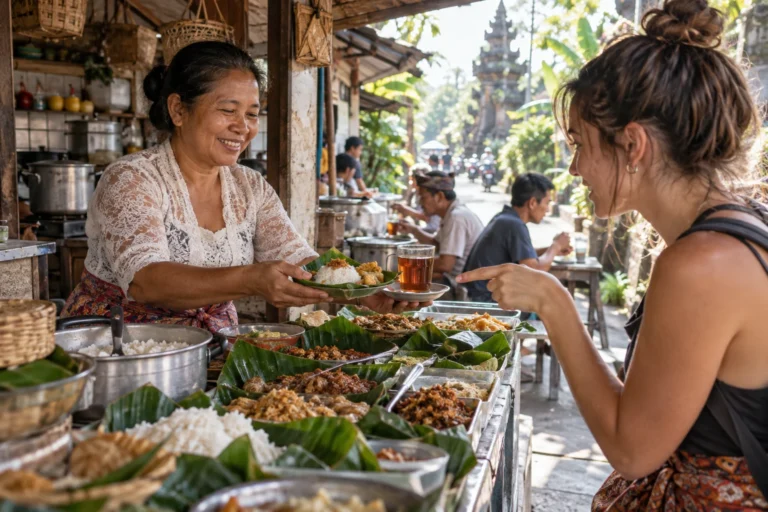
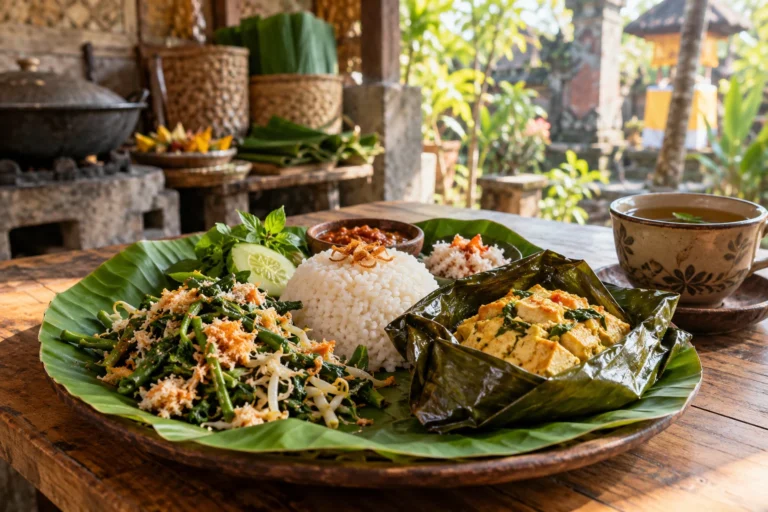
You can understand many Balinese morning foods by looking at a relatively small set of ingredients in different forms. Balinese breakfast ingredients include rice, vegetables, coconut, aromatics, chili, peanuts, banana leaves and traditional sweets made from rice flour or palm sugar. What changes is the cook’s treatment of those ingredients and the kind of meal being prepared.
This is an ingredient guide for travelers, not a universal shopping list. A packet of nasi jinggo, a bowl of porridge and a plate of tipat cantok use different combinations, and no household uses every ingredient for breakfast every day.

Rice in more than one form
Steamed rice often provides a neutral center for seasoned sides. Rice cooked much more softly can form the base of a savory porridge. Rice pressed or wrapped into cakes can be cut and paired with sauce. Rice flour can become a tender cake or sweet snack.
Recognizing these forms makes food descriptions more useful. Instead of seeing five unrelated dishes, you can notice how one staple changes texture, transportability and the way it carries flavor.
Coconut adds texture as well as richness
Freshly grated coconut can sit on vegetables or sweets; coconut milk can give a broth or sauce body; coconut-based components can bring aroma and richness. The terms grated coconut and coconut milk are not interchangeable, and a particular dessert may use one, the other or both.
For dietary planning, remember that plant-based ingredients are not a guarantee that the entire dish is vegan. A sauce can have coconut and still contain chicken stock or shrimp paste.
Aromatic roots and alliums
Shallots, garlic, turmeric, ginger, galangal and kencur appear across Balinese cooking, though not necessarily together in every recipe. Lemongrass and fragrant leaves can contribute aroma without the same sort of heat that chili provides.
Their preparation matters. A chopped shallot, bruised lemongrass stalk and ground spice paste release flavor differently. Seeing ingredients at a market is a useful first step, but tasting how they change during cooking is where the knowledge becomes practical.
Chili and sambal are not the whole dish
Balinese food may be known to visitors for strong chili flavors, but spice is more complex than hotness. Sambal can be served separately from rice or mixed into a preparation, and people have different preferences.
If you want a milder breakfast, ask about the sauce and paste itself. Removing a separate spoonful of sambal may not reduce heat already cooked into the main dish.
Peanuts and legume products
Peanuts can form a savory dressing for rice cakes and vegetables. Tofu and tempeh can be convenient side dishes with rice. Ingredients based on soy or peanuts are important to identify for travelers with allergies, and a sauce may contain an ingredient that is not visible after grinding.
Do not assume a tofu or tempeh dish is free of meat-based stock or fish seasonings without asking the cook. The complete preparation is what determines suitability.
Banana leaves are not only decoration
Banana leaves can wrap small rice packets, help serve food and be used during some cooking methods. They create a practical package and are part of the visual and tactile experience of market food.
But a leaf does not automatically prove a dish was cooked inside it or that the food is free of other packaging materials. If a technique interests you, ask how the wrapping was used.
Palm sugar, pandan and morning sweets
Palm sugar gives traditional sweets a distinctive sweetness, while pandan can contribute fragrance and color depending on the preparation. Rice flour and coconut help shape the texture of jaje and other market snacks.
Looking at these ingredients also explains why sweets may be soft, sticky, chewy or granular rather than resembling Western baked cakes.
How to read an unfamiliar food stall
Start with the staple. Is the dish based on rice, rice cake, noodle, vegetable or flour? Then identify what provides the main flavor: a cooked spice mixture, a peanut sauce, coconut richness or palm sugar. Finally, ask about the protein, toppings, heat level and anything you must avoid.
These questions are more useful than assuming the ingredients from a menu photograph. Sellers may change recipes with the season or available produce.
Moving from the market to a family kitchen
Putu’s Pejeng market-and-cooking experience connects produce and aromatics with the later hands-on session. Guests prepare five agreed dishes in the family compound and then enjoy the meal together. It is a cooking experience rather than a guarantee of every breakfast food described here.
If you want to see how ingredients are chopped, ground and balanced, a private Ubud cooking class can be a natural continuation. Discuss dietary requirements and menu ideas before booking so that the host can confirm what is realistic.
A market shopping sequence for curious home cooks
Begin with rice and the form it will take in the meal. Next identify whether the dish needs fresh vegetables, a paste, a sauce or a sweet topping. Only then consider the finishing ingredients such as sambal, grated coconut or fragrant leaves. This sequence mirrors the way a cook thinks backward from a finished plate rather than shopping for a dozen unfamiliar ingredients without a plan.
If you intend to recreate a dish outside Indonesia, some ingredients may be difficult to find. Substitute cautiously and record what the original cook says about an ingredient’s job. Replacing a fragrant leaf is a different problem from replacing the base of a peanut sauce.
Learning an ingredient’s role is more valuable than treating a recipe as a fixed list to be copied without understanding. The broader guide to Balinese breakfast foods shows how similar ingredients can take different forms across morning dishes.
A useful way to keep learning
Choose one ingredient on your next breakfast plate and follow it backward. If you see coconut, ask whether it was grated or squeezed for milk. If you see rice cake, ask how it was prepared. If the dish tastes fragrant, try to identify which aromatics might be involved.
That small habit turns an ordinary morning meal into a lesson about technique without pretending that every dish needs an elaborate explanation.