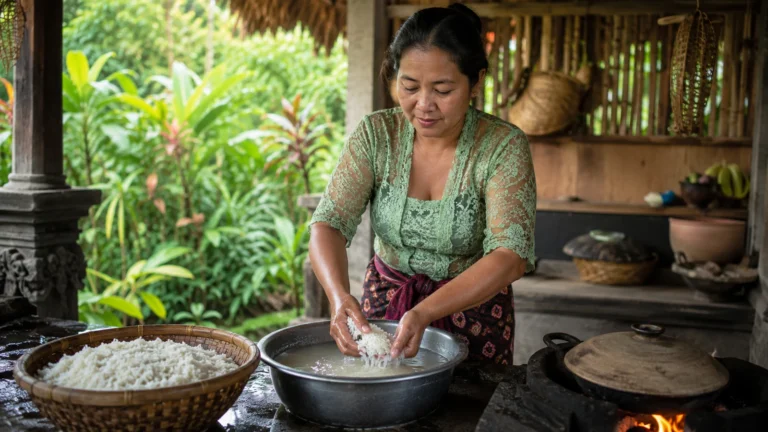
A stone mortar and pestle is one of the most useful tools for understanding Balinese spice paste because it lets the cook feel ingredients change from chopped pieces into a cohesive mixture. In a cooking lesson Ubud, the tool is often used to demonstrate texture and ingredient order rather than simply to create a rustic appearance.
The practical method is straightforward: cut fibrous ingredients first, work in a manageable batch, begin with ingredients that benefit from friction, then add wetter or softer ingredients as the paste develops. The exact order varies by recipe, but overfilling the mortar almost always makes the work slower and less controlled.
For the bigger picture, traditional Balinese cooking methods explains where hand grinding fits among steaming, frying, grilling, coconut preparation, and rice cooking. The separate guide to base genep spice paste also helps explain why one paste may contain many aromatics rather than a single dominant spice.
Choose a Stable Mortar Before You Start
A heavy mortar should sit on a firm surface without rocking. Many cooks place a folded towel or non-slip mat underneath when working on a smooth counter. Stability matters because the pestle is used with downward pressure and a circular crushing action. If the bowl slides, the cook tends to compensate with awkward force.
Stone surfaces vary. Some are very rough when new and gradually become smoother with use. Before first use, follow the maker’s care instructions and make sure no loose grit remains. In a household kitchen, a mortar used for food should be kept separate from decorative or non-food objects that may look similar.
Cut Fibrous Aromatics Before Grinding
Lemongrass, galangal, turmeric, ginger-like roots, and tough chilies become easier to grind when they are sliced into small pieces first. The mortar is good at crushing, but it is inefficient at breaking long fibers that could have been shortened with a knife. Shallots and garlic can be roughly chopped if they are large.
Understanding the difference between fresh and dried Balinese spices also helps. Dried seeds or spices behave differently from juicy shallots and fresh roots. A paste becomes easier to control when the cook knows which ingredients release moisture and which mainly need crushing.
Work in Layers Rather Than Dumping Everything In
A crowded mortar gives the pestle nowhere to move. Ingredients bounce, spill, or remain as large pieces around the edge. Start with a smaller quantity and grind until the mixture begins to break down. Add the next ingredient only when the bowl has enough space to keep working effectively.
Some cooks begin with salt or drier ingredients because they create friction. Others follow a family sequence built around a particular recipe. There is no need to invent one universal order. The useful principle is to avoid adding so much wet material early that the ingredients simply slide around instead of being crushed.
Use Pressure, Crushing, and Smearing
Pounding straight down is only one movement. Pressing, twisting, and smearing the mixture against the rough surface can be more efficient for soft aromatics. The pestle can push ingredients from the wall back toward the center, crush stubborn pieces, and work the paste until separate smells begin to merge.
The sound changes as well. Hard chopped pieces produce sharper impacts; a developing paste sounds heavier and more muted. These sensory cues help the cook decide when to stop. A traditional spice paste does not always need the texture of baby food. A slightly coarse but even mixture may fry beautifully.
Know What Finished Texture You Need
A paste destined for a long simmer can tolerate more texture than one used as a thin coating. If woody pieces remain, keep grinding or remove them. If the mixture is already cohesive and spreads easily in the pan, continuing until perfectly smooth may add effort without improving the dish.
After grinding, the paste usually still needs cooking. A Balinese cooking class meal can show the difference between the raw smell of freshly crushed aromatics and the rounder aroma that develops when the paste is fried and moisture reduces.
Clean the Mortar Soon After Use
Oily spice paste, chili, turmeric, and garlic can dry into the pores if the mortar is left dirty. Scrape out as much paste as possible, rinse and wash according to the material and manufacturer guidance, then dry thoroughly. Avoid storing a wet stone mortar in a closed cupboard where moisture and odor can linger.
If the mortar has persistent cracks, sheds grit, or develops a surface that cannot be cleaned reliably, it should be inspected before continued food use. Traditional equipment earns its place by working safely and well, not merely by being old.
A Blender Is a Practical Alternative, Not a Failure
For a large quantity, a blender or food processor can be more efficient. Reduce added water where possible, pulse in stages, scrape the sides, and stop before the mixture becomes unnecessarily thin. If extra liquid is required for the blades to circulate, plan for additional reduction in the pan.
The best way to learn the mortar is to use it for a small batch and pay attention to the texture. Once you understand what hand grinding produces, it becomes much easier to decide how a modern appliance should be adjusted to reach a similar cooking result.
A Repeatable Way to Practice the Technique
For how do you use a stone mortar and pestle to make balinese spice paste efficiently and safely, the most reliable learning method is to change one variable at a time and observe the result. Keep the ingredient quantity manageable, prepare the work area before heat begins, and note which visual, aromatic, or textural cue tells you that the step is complete. This turns Balinese mortar and pestle into a repeatable skill instead of a single recipe memory. If equipment or ingredients differ at home, preserve the function of the step and adjust gradually rather than copying a movement that no longer fits the situation.
Use the Next Step as Your Quality Check
A useful final check for Balinese mortar and pestle is whether the technique made the next stage easier. Preparation should reduce long fibers before grinding, wrapping should contain food without fighting the leaf, heat should create the intended texture without forcing the cook to rescue the surface, and cleaning should leave the tool ready for another meal. When the next stage becomes harder, revisit the preceding decision instead of adding more complexity. This process-based approach keeps traditional methods practical for a modern home kitchen.