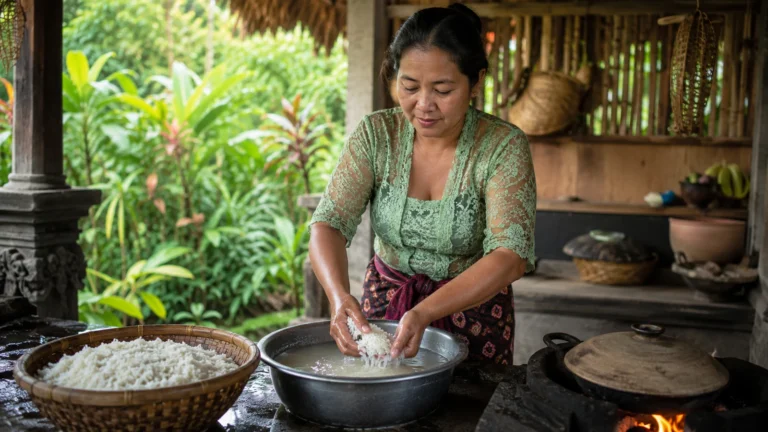
Grinding spices by hand and blending them with an electric appliance can produce two perfectly usable Balinese spice pastes, but they are not mechanically identical. Hand grinding crushes and smears small quantities against a rough surface. Blending chops rapidly inside a container and often needs enough moisture for the ingredients to circulate. Travelers who join a cooking course Ubud can see these differences before deciding which method makes sense at home.
The most noticeable differences are texture and moisture. A mortar can leave a fine but slightly irregular paste, while a blender tends to create a more uniform puree. If water is added to help the blades move, the paste may need longer frying before its flavor feels concentrated.
The broader guide to Balinese kitchen techniques explains why this matters in the full cooking sequence. The comparison also makes more sense when you know the behavior of fresh versus dried spices, because juicy aromatics and dry seeds respond differently to each tool.
Grinding Uses Compression and Friction
A pestle does more than cut ingredients. It presses them into the mortar, crushes cell structure, and smears the mixture across the surface. The cook can target a stubborn piece and stop when the texture is appropriate. This control is especially useful for small quantities.
Because little or no added liquid is required, the paste can remain relatively dense. That density changes how it hits hot oil: less water may need to evaporate before the aromatic mixture begins to fry. The exact result still depends on the ingredients and batch size.
Blending Uses Fast Cutting and Circulation
A blender relies on rapidly moving blades. For the blades to contact everything evenly, the ingredients need to fall back toward the cutting zone. Small dry batches can ride above the blades or stick to the jar, which is why cooks sometimes add water or oil.
That extra liquid is not automatically a problem. It simply becomes part of the cooking calculation. A wetter paste may spend more time bubbling as moisture escapes before oil becomes visible around the edges. Judging doneness by time alone can therefore be misleading.
Texture Changes the Way the Paste Cooks
A slightly coarse paste has more visible fragments and can provide a rustic texture. A very smooth puree spreads evenly and may cling differently to meat, tofu, vegetables, or a pan. Neither texture is universally correct. The recipe and the desired final mouthfeel decide which is useful.
The main Balinese spice-building basics are still more important than loyalty to one machine. Freshness, ingredient balance, proper trimming, and enough cooking time can matter more than whether the crushing happened in stone or stainless steel.
Heat from the Tool Is Only Part of the Story
High-speed blending can warm a small batch, especially if the machine runs for a long time. Hand grinding also creates friction and can warm ingredients gradually. It is better to focus on practical outcomes—aroma, texture, moisture, and cooking behavior—than to claim that one method preserves every volatile compound while the other destroys it.
Short pulses, pauses, and small batches can limit unnecessary heating in a blender. A mortar naturally works more slowly, giving the cook frequent opportunities to smell and feel the mixture.
Ingredient Order Still Matters
A blender is not an excuse to skip preparation. Long lemongrass fibers, large chunks of galangal, and whole tough roots should still be cut smaller. Hard and soft ingredients can be processed in stages if necessary. Scraping the jar prevents large pieces from hiding above the blades.
In a mortar, ingredient order is even more visible because the cook adds layers gradually. Drier ingredients can provide friction; wet shallots and garlic can help bind the paste later. Family recipes may use different sequences, but the logic is to keep the tool working efficiently.
Choose the Method for the Batch You Actually Have
A mortar is excellent for a small quantity that the cook wants to control closely. A blender is efficient for a family-size batch or when time and physical effort matter. A food processor can be useful when a wider bowl handles chopped ingredients better than a narrow blender jar.
If the tool requires extra liquid, reduce it later. If the mortar leaves large fibrous pieces, keep cutting or grinding. Practical adaptation is more useful than trying to prove that one technique is the only legitimate one.
Storage Depends on the Finished Paste, Not the Tool
Regardless of how the paste was made, safe storage matters once it is finished. The guide to safe storage for homemade spice paste covers cooling, clean containers, refrigeration, and signs that a batch should not be used.
The most useful comparison is therefore not tradition versus technology. It is whether the chosen tool gives you the texture, moisture level, quantity, and control needed for the next cooking step. Once those variables are understood, both methods can produce excellent food.
A Repeatable Way to Practice the Technique
For why can a hand-ground balinese spice paste feel and cook differently from one made in a blender, the most reliable learning method is to change one variable at a time and observe the result. Keep the ingredient quantity manageable, prepare the work area before heat begins, and note which visual, aromatic, or textural cue tells you that the step is complete. This turns grinding spices vs blending into a repeatable skill instead of a single recipe memory. If equipment or ingredients differ at home, preserve the function of the step and adjust gradually rather than copying a movement that no longer fits the situation.
Use the Next Step as Your Quality Check
A useful final check for grinding spices vs blending is whether the technique made the next stage easier. Preparation should reduce long fibers before grinding, wrapping should contain food without fighting the leaf, heat should create the intended texture without forcing the cook to rescue the surface, and cleaning should leave the tool ready for another meal. When the next stage becomes harder, revisit the preceding decision instead of adding more complexity. This process-based approach keeps traditional methods practical for a modern home kitchen.