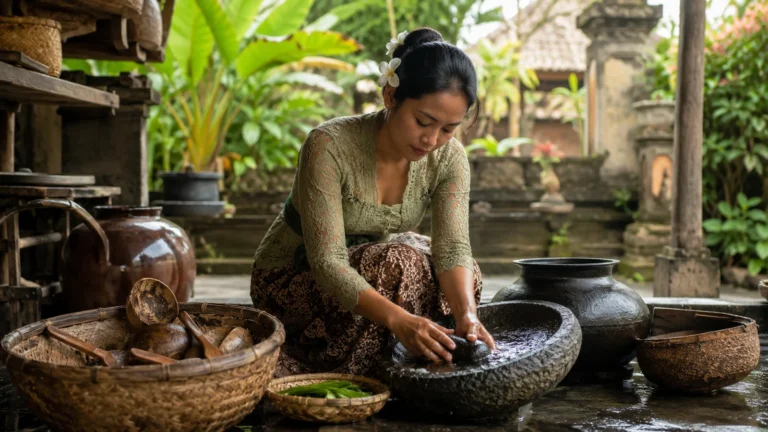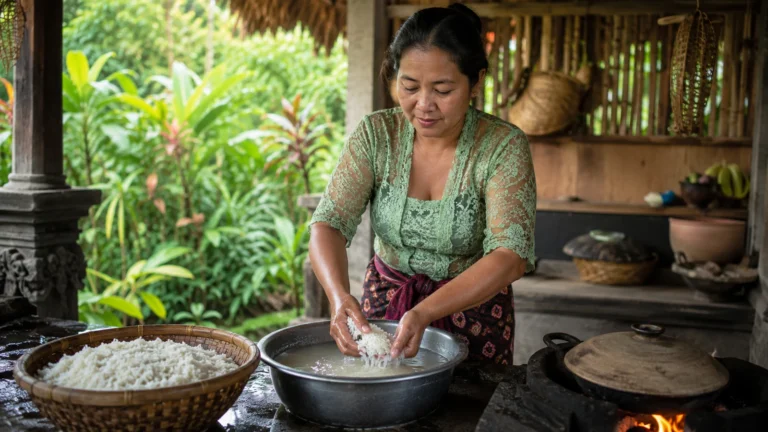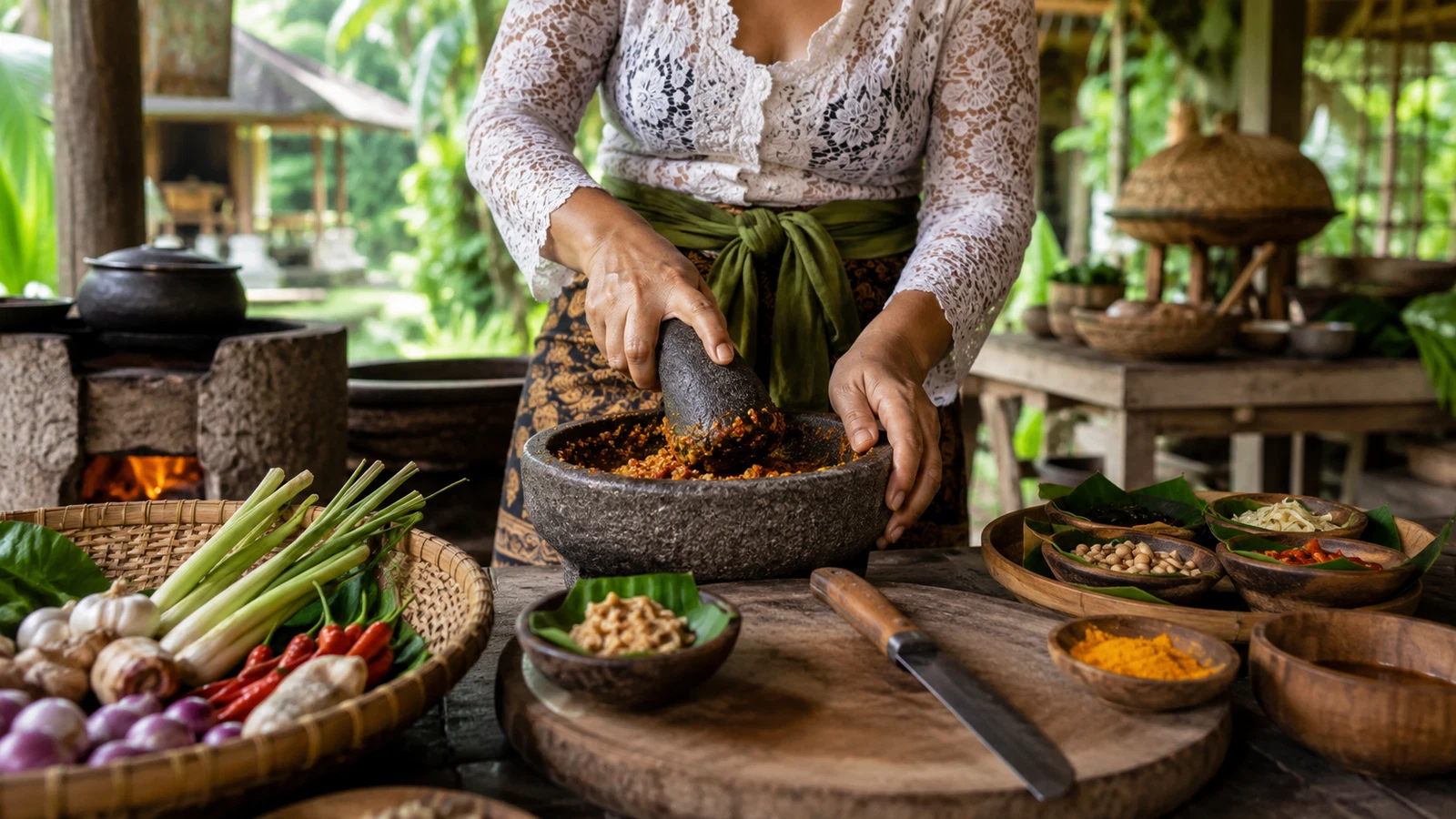
Traditional Balinese cooking is defined as much by method as by ingredients. Grinding aromatics by hand, softening banana leaves, controlling charcoal heat, steaming wrapped foods, frying in small batches, grating coconut, and timing rice all change how a dish tastes and feels. A ubud cooking class can make these movements easier to understand because the tools are used in sequence rather than displayed as cultural props.
The useful question is not whether every traditional tool is better than a modern appliance. It is what each method does to texture, moisture, heat, aroma, and workflow. A stone mortar can create a coarse cohesive paste; a blender can save time but may need extra liquid. Banana leaves can hold steam and aroma; a metal or heatproof container can sometimes replace them. Charcoal gives direct radiant heat and smoke, while a stovetop or grill pan may be easier to control at home.
Before focusing on technique, it helps to understand the ingredients being transformed. The broader guide to Balinese spice preparation explains the fresh roots, chilies, shallots, garlic, and other aromatics that often move through several of these tools. Market quality also matters, so fresh ingredients from a traditional market provide useful context for why preparation may change from one day to another.
Why Technique Matters in Balinese Cooking
A recipe can list the correct ingredients and still produce a flat result if the preparation is rushed. Fibrous roots need to be cut small enough to grind. Shallots and garlic release moisture as they are crushed. A spice paste usually needs cooking time after grinding so its raw sharpness softens. Rice has to be ready when multiple side dishes are finished. These are practical relationships between preparation and timing, not decorative traditions.
Technique also affects how a cook works with a household kitchen. A large restaurant can standardize equipment, but home cooking often uses whatever combination of old and new tools is practical. The same cook may grind a small quantity by hand, use a blender for a larger batch, steam one dish, fry another, and finish a skewer over charcoal. Understanding the purpose of each step is more useful than insisting on a single supposedly authentic setup.
Grinding Spice Paste with a Stone Mortar
One of the most recognizable tools is a heavy stone mortar and pestle. The detailed guide to using a stone mortar for spice paste explains why small batches, sensible ingredient order, and repeated pressure work better than filling the bowl and pounding randomly. The goal is not always a perfectly smooth puree. Many Balinese pastes benefit from a texture fine enough to cook evenly while still retaining body.
Harder or fibrous ingredients are usually cut before grinding. Salt can help create friction in some preparations, while wetter ingredients are often added after the first aromatics have broken down. The cook watches the paste rather than following a fixed number of strokes. When the mixture begins to bind, smell integrated, and spread without large woody pieces, it is ready for its next cooking stage.
Grinding and Blending Are Not Identical
Electric blending is convenient, especially for larger quantities, but it changes the process. The comparison of hand grinding versus blending spices looks at texture, added liquid, friction, batch size, and how the paste behaves in the pan. A blender often creates a more uniform puree and may require water or oil to circulate. A mortar lets the cook feel resistance and stop at a coarser texture.
Neither method should be treated as morally superior. If a traveler wants to recreate a dish at home, the best choice depends on time, equipment, quantity, and the desired texture. What matters is compensating intelligently: use less added liquid when possible, scrape the blender jar thoroughly, and allow a wet paste enough cooking time to reduce before judging its flavor.
Preparing Banana Leaves for Cooking
Banana leaves are useful wrappers, liners, and cooking surfaces, but a fresh leaf is not automatically ready to fold. The guide to preparing banana leaves for cooking covers cleaning, trimming, softening, cutting, and dealing with the central rib. Brief warmth makes many leaves more flexible, which reduces splitting when they are folded around food.
For steaming, the leaf mainly needs to hold its shape and allow the parcel to sit securely above the water. For grilling, the wrapper must also tolerate direct heat long enough to protect the food. Small tears can sometimes be patched with a second layer. The leaf should support the dish, not become a reason to ignore basic food safety or heat control.
Controlling Charcoal Heat Instead of Chasing Flames
Charcoal grilling is most reliable when the cook waits for a stable bed of hot coals instead of cooking directly over high flames. The article on charcoal grilling in Balinese cooking explains heat zones, distance, turning, flare-ups, skewers, and wrapped foods. Browning comes from controlled heat; uncontrolled fire can blacken the outside before the center is ready.
A practical grill often has hotter and cooler areas. Food can begin over stronger heat for color and move to a gentler zone to finish. Sugary marinades and dripping fat need attention because they can encourage flare-ups. Smoke should be an ingredient in moderation. Heavy bitter smoke is usually a sign that the fire or fuel needs better management.
Steaming for Gentle, Moist Cooking
Steaming is common for soft cakes, dumpling-like foods, vegetables, and wrapped preparations. The guide to traditional Balinese steaming shows why steam flow, spacing, lid discipline, and condensation matter. A crowded steamer can cook unevenly, while weak steam can leave dense foods gummy rather than tender.
Steam is especially useful when a cook wants to heat food without immersing it in water. Banana-leaf parcels hold aroma close to the food and create a contained environment, but the parcel still needs sufficient steam around it. Modern steamers, stacked pots, or improvised racks can all work if they provide stable heat and keep the food above the water line.
Frying Crisp Ingredients in Manageable Batches
Crisp tempeh, tofu, and fried shallots each behave differently in oil. The guide to Balinese crisp-frying methods explains moisture control, oil depth, batch size, and draining. Adding too much food at once can lower the oil temperature, while wet surfaces increase splattering and slow browning.
Good frying is not simply about making oil extremely hot. Thin shallots can move from golden to bitter quickly. Tofu contains more water than a dry slice of tempeh. A cook adjusts time and batch size rather than forcing all ingredients through the same routine. Draining on a rack, strainer, or absorbent surface also matters because crispness can disappear if hot food sits in pooled oil.
Knife Work Prepares Ingredients for the Next Technique
Balinese cooking uses many small aromatics, so knife work is closely connected to grinding and frying. The article on knife skills for Balinese aromatics focuses on stable cutting, trimming fibrous roots, slicing shallots, bruising lemongrass, and preparing chilies. The objective is not showy speed. It is consistent pieces that match what happens next.
A piece of galangal meant to perfume a broth can remain larger than galangal destined for a spice paste. Lemongrass may be bruised in one dish and finely sliced in another. Shallots for crisp garnish need even thin slices so they brown together. Thinking one step ahead makes cutting safer and more purposeful.
Fresh Coconut Is an Ingredient and a Process
A mature coconut can become grated flesh, a garnish, a filling, or fresh coconut milk. The guide to opening and grating fresh coconut follows the sequence from shell to squeezed milk. Opening and grating require stable tools and attention because the hard shell and sharp equipment can make casual handling unsafe.
Once grated, coconut can be mixed with water and squeezed to extract milk. A richer first extraction and a lighter later extraction can be used differently depending on the dish. Fresh coconut is perishable, so small batches and prompt refrigeration are more sensible than leaving grated coconut or fresh milk at room temperature for long periods.
Rice Sets the Rhythm of a Multi-Dish Meal
Rice often anchors the timing of a Balinese meal. The guide to Balinese home rice preparation explains rinsing, judging water, cooking, resting, and coordinating the pot with side dishes. A fixed ratio can be a useful starting point, but rice variety, age, washing, pot shape, and cooking method all influence the result.
The rest period after cooking is easy to underestimate. Allowing the rice to sit briefly before fluffing helps moisture settle and makes serving more even. In a class or family kitchen, rice is often started early enough that attention can shift to spice paste, vegetables, fried components, and final garnishes without creating a rush at the end.
Caring for Tools Is Part of the Technique
Traditional tools last longer when care matches the material. The article on cleaning traditional cooking tools separates ordinary cleaning from food-safety sanitation and looks at stone, wood, bamboo, woven fiber, and metal. A stone mortar should not stay coated in oily spice residue, but aggressive chemicals or long soaking may be inappropriate for some porous or natural materials.
Tools should be washed promptly, dried thoroughly, and stored where air can circulate. Cracked cutting surfaces, deep grooves, loose handles, rust, or persistent odors are signs that a tool needs closer inspection. For food-contact items, cleanliness takes priority over nostalgia. If an object can no longer be cleaned reliably, replacing it is more sensible than preserving it for daily use.
Traditional Skills Can Work with Modern Equipment
Learning traditional technique does not require recreating an old kitchen exactly. A food processor can help with a large spice batch, an electric steamer can replace a stacked pot, a rice cooker can handle rice consistently, and a grill pan can provide controlled heat when charcoal is unavailable. The important step is understanding what the original method is trying to accomplish so the substitute preserves function.
That is also why hands-on cooking classes can be useful for travelers who want more than a recipe list. Watching the texture of a paste, feeling how a softened banana leaf folds, or seeing when charcoal is ready gives reference points that are difficult to learn from ingredient quantities alone.
A Practical Way to Learn the Techniques
Start with one process at a time. Learn how to prepare aromatics before trying to grind quickly. Practice wrapping a simple banana-leaf parcel before handling a wetter filling. Learn heat zones with sturdy vegetables before grilling delicate pieces. Fry small batches before scaling up. These sequences build confidence because each skill has visible feedback.
The larger lesson is that Balinese cooking techniques are interconnected. Cutting affects grinding; grinding affects frying; frying and steaming affect the timing of rice; tool care affects the next meal. Once those relationships are clear, recipes become easier to adapt without losing the logic that holds the food together.
How to Observe Technique During a Class
Instead of trying to memorize every recipe, watch for decision points: when ingredients are cut smaller, when a paste is considered ready, when the cook lowers heat, when a wrapper becomes flexible, and when rice is left to rest. These moments reveal the method behind the recipe and are easier to reproduce later than a long list of numbers.
Questions Worth Asking the Cook
Useful questions are specific and practical: What texture should this paste have before frying? Why is this ingredient bruised instead of chopped? How do you know the charcoal is ready? What modern tool would you use at home? Questions like these invite explanations about function without asking the host to defend whether one family method is the only traditional method.
A Repeatable Way to Practice the Technique
For which traditional cooking techniques and kitchen tools are most useful for understanding balinese food preparation, the most reliable learning method is to change one variable at a time and observe the result. Keep the ingredient quantity manageable, prepare the work area before heat begins, and note which visual, aromatic, or textural cue tells you that the step is complete. This turns Balinese cooking techniques into a repeatable skill instead of a single recipe memory. If equipment or ingredients differ at home, preserve the function of the step and adjust gradually rather than copying a movement that no longer fits the situation.