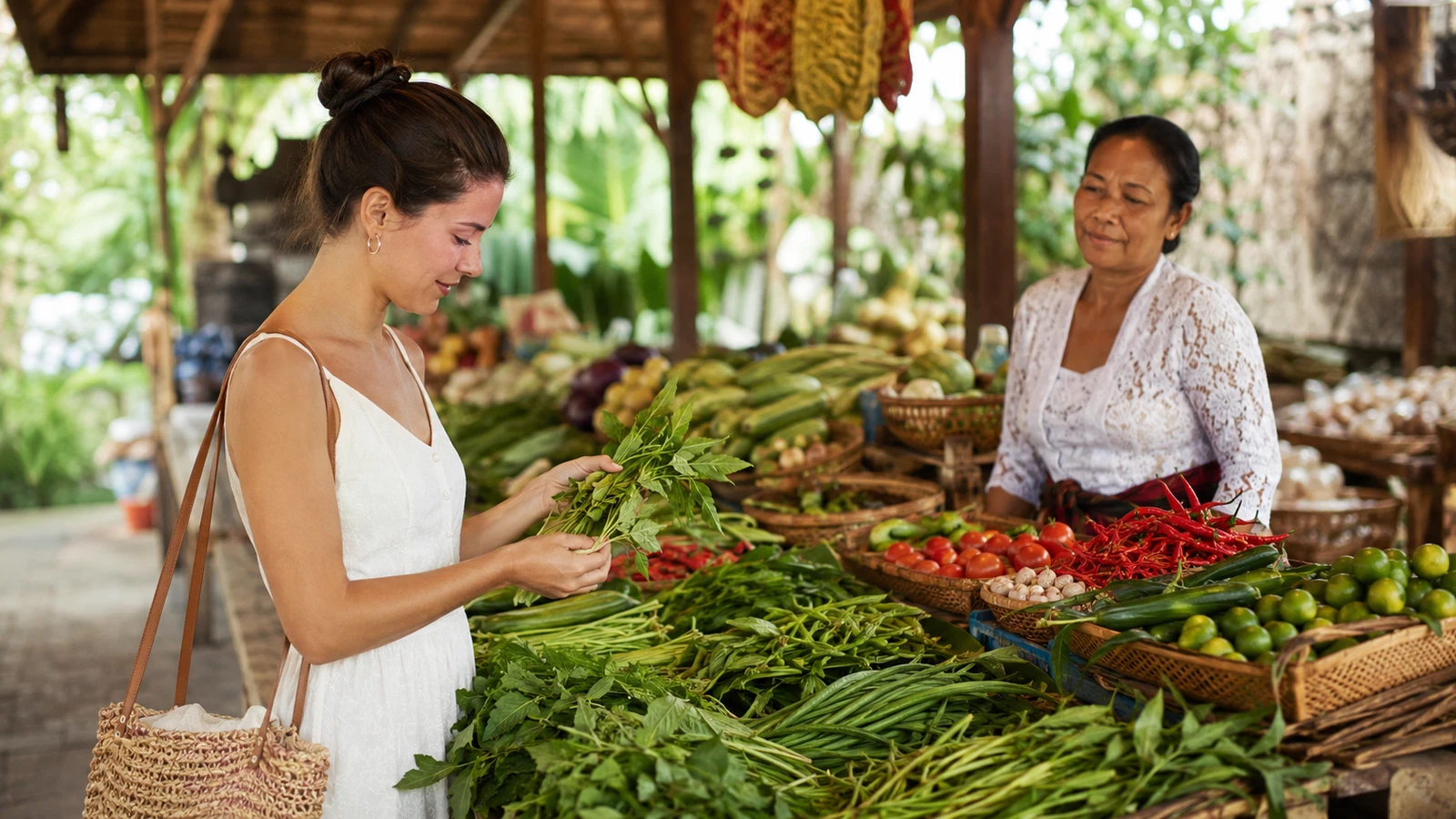
Banana leaves, coconut, and palm sugar appear in both everyday and celebratory Balinese cooking. They can wrap, steam, grill, enrich, sweeten, thicken, perfume, and present food. The best choice depends on the recipe, so a shopper needs more than a general idea of freshness. A broad leaf for wrapping, a mature coconut for rich milk, and a clean block of palm sugar each solve a different kitchen problem.
This subject becomes easier to understand during a traditional cooking class near Ubud, where the market visit has a clear purpose and the ingredients continue into preparation. The broader traditional Ubud market ingredients guide places choosing banana leaves, coconut, and palm sugar at a traditional market inside the complete market-to-kitchen process, while this article focuses on the practical decisions a traveler needs for this specific part of the experience.
Why This Part of the Market Visit Matters
Banana leaves are used as natural wrappers, liners, covers, and serving surfaces. Mature coconut provides firm flesh for grating and milk, while younger coconut is valued for softer flesh and refreshing liquid. Palm sugar is sold in blocks, rounds, or other forms and contributes sweetness with a deeper aroma than plain refined sugar.
The value of understanding choosing banana leaves, coconut, and palm sugar at a traditional market is not limited to shopping. It affects menu planning, ingredient quality, preparation time, waste, and the comfort of the group. A small decision at the stall can determine whether an ingredient folds, grinds, fries, simmers, or travels well later in the day.
What to Look For at the Stall
Choose banana leaves that are broad, reasonably intact, and flexible enough to soften further over gentle heat. Select coconut by intended use and ask the vendor when uncertain. Palm sugar should smell pleasantly sweet and caramel-like, with no visible mold, excessive dampness, or unpleasant fermented odor caused by poor storage.
Observation should remain respectful. For choosing banana leaves, coconut, and palm sugar at a traditional market, ask before touching several items, let the vendor demonstrate qualities that are difficult to see, and compare only the quantity the class may realistically buy. The aim is to learn how local cooks decide, not to inspect a vendor’s entire display without purchasing.
A Practical Step-by-Step Approach
Trim damaged leaf edges, wipe or rinse the surface appropriately, and pass the leaf briefly over gentle heat to improve flexibility before folding. Crack and grate mature coconut with suitable tools, then squeeze it with safe water when making milk. Chop or dissolve palm sugar gradually so sweetness can be adjusted during cooking.
Keep the explanation connected with the menu. When learning about choosing banana leaves, coconut, and palm sugar at a traditional market, identify what will happen next: washing, trimming, grinding, wrapping, cutting, frying, simmering, tasting, or storing. This makes the market detail useful rather than turning it into a list of unfamiliar names.
How It Connects with Balinese Cooking
Banana leaves can hold seasoned fish, chicken, tofu, rice, or grated coconut mixtures. Coconut milk supports sauces and sweets, while toasted grated coconut adds texture. Palm sugar balances chili, tamarind, citrus, and salt in savory food as well as desserts, but it should not be added heavily before the dish is tasted.
The article on a broader guide to unfamiliar Balinese ingredients provides a useful connection beyond the market. It shows how the same decision appears in an existing cooking or travel guide, allowing the new article to support rather than repeat information already available on the website.
Advice for First-Time Visitors
A market comparison is valuable because these ingredients may already be processed in a supermarket. Seeing whole coconut, freshly grated flesh, bundled leaves, and sugar from different producers explains why texture and aroma vary. Ask which form the class will use and why that form matches the cooking method.
A second useful reference is the Balinese meal prepared after shopping. Reading it before the activity helps visitors understand what is included, which questions to ask, and how choosing banana leaves, coconut, and palm sugar at a traditional market fits into a real class or meal instead of remaining an isolated market observation.
Common Mistakes to Avoid
Common errors include buying brittle leaves that split when folded, choosing young coconut for a recipe that requires rich mature flesh, or assuming darker palm sugar is automatically better. Another problem is allowing damp sugar or grated coconut to remain warm for too long before cooking.
Most errors around choosing banana leaves, coconut, and palm sugar at a traditional market come from rushing, assuming every market follows the same routine, or purchasing without considering transport and storage. A host can prevent those problems by confirming the menu, timing, and quantity before the group begins buying.
Clean Handling and Safety
Use clean tools for cracking and grating coconut, protect hands from sharp edges, and keep fresh coconut cool when it will not be cooked immediately. Wash leaf surfaces appropriately and discard moldy sugar or coconut with rancid, sour, or otherwise abnormal odor.
Safety around choosing banana leaves, coconut, and palm sugar at a traditional market does not require treating a traditional market with suspicion. It requires the same continuous care used in any food setting: choose sound ingredients, prevent cross-contamination, control time and temperature when relevant, and continue with clean preparation in the kitchen.
Questions Worth Asking the Host or Vendor
Useful questions about choosing banana leaves, coconut, and palm sugar at a traditional market include how the item is normally prepared, whether it is intended for immediate use, which signs show good quality, and what changes when the preferred option is unavailable. These questions reveal practical local knowledge without asking a vendor to deliver a long formal explanation during a busy transaction.
Another helpful question is what the group should notice later in the kitchen. With choosing banana leaves, coconut, and palm sugar at a traditional market, the answer might be aroma after grinding, texture after cooking, flexibility after warming, sweetness after dissolving, or the way a fresh ingredient carries spice. Linking the stall to a specific sensory result makes the lesson easier to remember.
The Main Lesson to Take into the Kitchen
These three market ingredients reward careful selection because their physical condition affects the recipe immediately. Pliable leaves, suitable coconut maturity, and clean aromatic palm sugar make wrapping easier, sauces richer, and sweetness more balanced.
Once travelers understand choosing banana leaves, coconut, and palm sugar at a traditional market, the market feels less confusing. They can notice quality, purpose, and preparation instead of seeing only color and activity. That shift is what turns a short shopping stop into a meaningful part of a Balinese cooking experience.

