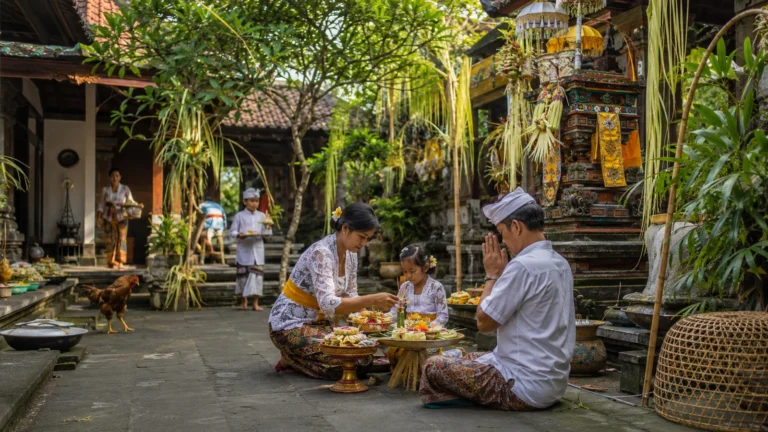
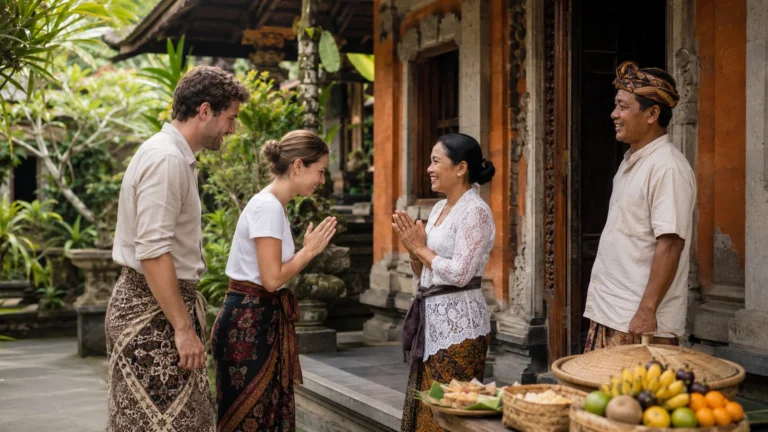
Photographs can preserve the colors, food, tools, and atmosphere of a Balinese family home, but the home is not a public studio. People live, pray, work, rest, and raise children there. Guests attending an ubud cooking class should treat consent as part of every meaningful image. The Balinese family compound etiquette guide explains the wider etiquette of entering the compound.
The simplest rule is to ask before photographing people or sacred areas. Permission for one subject does not automatically cover every person in the frame, every room, or every moment later in the day. A camera should follow the relationship with the host, not take control of it.
Ask for the subject, not just the camera. “May I photograph the dish we’re preparing?” is a different request from “May I photograph your child behind the table?” Even in a place where guests are warmly welcomed, private conversations, household work, and religious practice can continue around the cooking area. Frame photographs narrowly, check the background, and accept a quiet “not now” without asking for a reason.
For a cooking class, a good first request is practical: ask the host which moments are suitable for a photo and when hands need to stay on the ingredients instead. That makes it easier to take a few useful images without repeatedly interrupting instruction or moving around hot equipment for a better angle.
Ask Before the Camera Comes Up
Make the request visible and understandable. Pointing silently at a camera can work in some situations, but a clear question is better when language allows. Wait for an answer, and do not treat hesitation as consent.
Ask again when the context changes. A host who agrees to a photograph while chopping vegetables may not want a photograph during prayer or while helping a child.
Protect Children and Family Privacy
Parents or guardians should decide whether children can be photographed. Do not post a child’s image simply because the child smiled at the camera. Avoid capturing documents, house numbers, private messages, bedrooms, or personal items that reveal more than the family intended.
When sharing online, describe the experience without publishing sensitive family details. Hospitality does not make a household’s private life public property.
Treat Shrines and Offerings as Sacred
Do not step into a shrine, lean over a boundary, move an offering, or ask someone to repeat prayer for a photograph. If the host says photography is not appropriate, put the camera away immediately.
Flash can be intrusive and visually harsh. Even when photographs are allowed, natural light and a respectful distance usually produce a better record of the atmosphere.
Do Not Interrupt Food Preparation
Cooking includes moments when the host needs full attention: handling hot oil, explaining knife safety, checking a spice paste, or coordinating several dishes. Wait until the step is stable before asking for a photograph.
A staged image is safest when the cook suggests it. Do not ask someone to hold a hot pan longer, repeat a risky knife motion, or move food away from the correct workstation for a cleaner background.
Photograph Participation, Not Only Display
Images become more meaningful when they show hands learning a technique, ingredients changing texture, or a meal reaching the table. Participate first, clean your hands, then ask someone else to take the photograph if appropriate.
Travelers can review the website gallery for an idea of the experience, while remembering that each visit has different people, light, ingredients, and household activity.
Use the Same Respect at Markets
Market vendors and shoppers also deserve consent. The guide to market photography etiquette explains why buying an item does not automatically purchase a person’s image.
Avoid blocking narrow paths, photographing financial transactions closely, or treating someone’s work as a costume. A brief conversation before the photograph often creates a more respectful and more memorable result.
Posting is a separate decision from taking the photograph. Before putting a close-up of a host, child, home altar, or another guest online, ask whether they are comfortable with public sharing, tagging, and location details. A yes to taking a group photo for your own memories does not automatically mean yes to posting it on an open social account. When uncertain, share the finished food and your own experience rather than identifying other people or parts of their home.
Share Images Responsibly
Before posting, consider whether the image reveals a sacred moment, a child, a private area, or a family member who did not agree to public sharing. The family-home experience is personal, and online context can travel far beyond the original visit.
Accurate captions matter. Do not invent ritual meanings or claim that an ordinary household moment represents every Balinese family. When unsure, describe what you actually did and learned.
Consent Creates Better Memories
Respectful photography is not a barrier to good images. It creates trust, keeps people comfortable, and helps the photographer notice the experience instead of chasing constant content.
Ask clearly, protect private and sacred moments, avoid interrupting work, and accept every refusal gracefully. The resulting photographs will carry a more honest memory of the visit.
Building a Simple Photography Agreement
At the beginning of the visit, ask what can be photographed and what should remain private. The host may allow food, tools, and guest participation while excluding the shrine, children, or certain relatives. Repeating that agreement in simple words prevents confusion later.
Group members should follow the same boundaries. One person receiving permission does not mean everyone can move into a sacred or private area with a camera. Share the host’s instructions with companions, especially when they arrive at different times.
Short video requires extra care because it records voices, background activity, and longer sequences. Ask separately before filming. Avoid live streaming from a private home unless the host has clearly agreed and understands what will be broadcast.
After taking a portrait, showing the image to the person can be a courteous gesture. If they ask for it not to be used, delete it. Consent is meaningful only when the person can change their mind.
Choosing What Not to Photograph
Some of the most respectful decisions happen without asking. Put the camera away when someone is upset, a child is changing clothes, money is being counted, medicine is visible, or the family is handling a private conversation. These moments do not become suitable subjects simply because they occur near the cooking activity.
Avoid photographing from hidden angles or using a long lens to bypass a boundary. Consent depends on people knowing they are being recorded. A technically possible image can still be inappropriate.
When editing, do not crop or caption an ordinary object so that it appears sacred, impoverished, or exotic for attention. Honest images preserve context. If the photograph needs a dramatic invented story to be interesting, it is probably not representing the family fairly.
A limited number of thoughtful photographs usually tells the story better than hundreds of interruptions. Choose a few moments: ingredients before cooking, one technique, the finished dishes, and a group photograph if everyone agrees. This approach leaves more time to listen, taste, and participate while still preserving a clear visual memory. It also reduces the chance of recording private background moments unintentionally during a busy household visit.