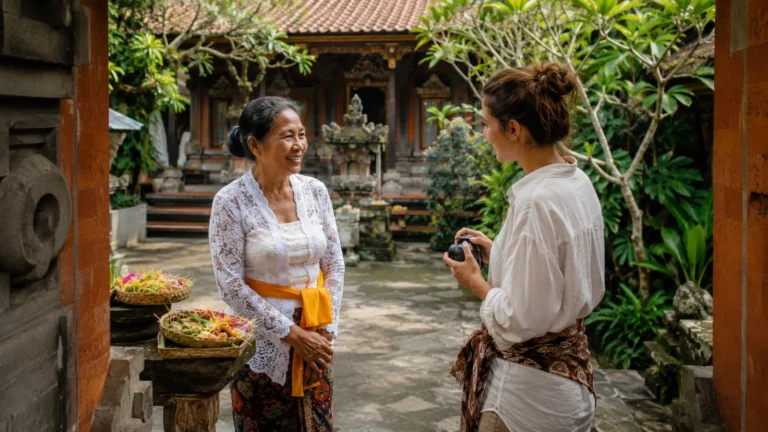
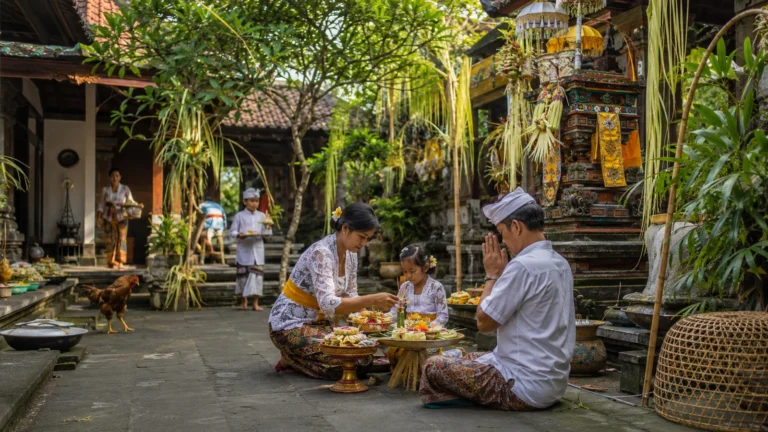
A Balinese family compound is not simply a decorative setting. It is a lived-in home where several parts of family life can meet: sleeping, cooking, prayer, gardening, receiving guests, preparing offerings, and organizing ceremonies. For travelers, joining an ubud cooking class in this environment can make local food easier to understand because the kitchen is connected to the household rather than separated from it as a tourist display.
Traditional compounds are generally organized as a group of structures around one or more courtyards, but no two homes should be expected to look identical. Land size, family history, rebuilding, modern plumbing, changing work patterns, and the number of relatives living on the property all affect the result. A visitor should therefore treat architectural terms as a guide, not as a checklist used to judge whether a home is sufficiently traditional.
The most useful way to approach the experience is with curiosity and restraint. Notice how spaces are used, ask before entering unfamiliar areas, and follow the host’s instructions around shrines, offerings, tools, and photography. Reading the story of Putu’s home-cooking experience also helps place the visit within a real family context rather than an abstract idea of Balinese culture.
First, read the threshold. In a Balinese compound, the entrance gate marks a change from the public lane to someone’s private household. You may notice a central courtyard connecting separate pavilions and, in some homes, a family shrine set apart from ordinary activity. Architectural vocabulary can help you ask better questions, but it is not a map you are entitled to follow. The family decides which spaces are open to guests.
One useful distinction is between recognizing a place and entering it. You might see an angkul-angkul gate, the shared courtyard known as the natah, or a household shrine called a sanggah or merajan. These terms describe features found in many traditional homes; the layout and use vary from family to family. If you would like to know what a structure is used for, ask the host from the area where you have been invited to stand rather than walking into it to investigate.
A Home Made of Connected Spaces
Many traditional Balinese homes are compounds rather than single enclosed buildings. Separate pavilions may serve different household functions, while the courtyard links movement between them. An entrance gate, a screening wall, sleeping or gathering pavilions, a kitchen area, storage, and a family shrine may all form part of the whole. The article on how a family compound is arranged explains these elements in more detail and also shows why modern versions often differ from textbook diagrams.
The open organization supports tropical ventilation and allows tasks to spread across several areas. Vegetables may be washed near one work surface, spices ground in another place, and serving plates arranged closer to the dining area. During a busy household event, courtyards and pavilions can become flexible working spaces. Their value lies not only in appearance but in how they support repeated routines over many years.
The Family Shrine Is Part of the Household
A family shrine, often referred to as a sanggah or merajan depending on local and family usage, is a sacred part of the compound. It is not a decorative garden feature. Daily devotion, family observances, and larger ceremonies can give this area a steady place in household life. The guide to the role of the family temple explains why visitors should wait for an invitation before approaching it and should never assume that an open gate means public access.
The presence of a shrine also helps explain why ordinary household movement may be guided by ideas of sacred and less-sacred space. Guests do not need to memorize a complicated system before visiting. They do need to recognize that family members may pause for prayer, prepare offerings, or temporarily restrict access to an area. Quiet cooperation is more respectful than demanding a full explanation at an inconvenient moment.
The Kitchen Reveals How Food Is Really Prepared
A home kitchen may combine old and new tools. A heavy stone mortar can sit near a gas burner, refrigerator, blender, woven tray, and stainless-steel pot. Some households retain wood-fired cooking for particular dishes or occasions, while others use modern heat for everyday convenience. The article about the traditional home kitchen describes preparation surfaces, ventilation, storage, spice tools, washing, and the practical reasons a family may adapt its kitchen over time.
For a guest, the most important detail is the workflow. Balinese cooking often involves many fresh aromatics, several cutting stages, grinding, frying a spice paste until fragrant, and coordinating rice with multiple side dishes. A class connected with a home-cooked Balinese meal can show how these parts come together without pretending that every family uses the same equipment or exact recipe.
Gardens Connect the Courtyard to the Table
A compound may include fruit trees, herbs, flowers, shade plants, and useful leaves, although the available space varies widely. Coconut, banana, papaya, citrus, pandan, chili, turmeric, lemongrass, or ceremonial flowers may be found in some homes, while other ingredients still come from a nearby market. The discussion of homegrown ingredients explains how a small garden can support cooking, offerings, fragrance, shade, and seasonal awareness.
Homegrown does not mean self-sufficient. A family may harvest a handful of leaves or fruit at home and buy rice, vegetables, tofu, tempeh, meat, spices, and coconuts elsewhere. This combination is normal. The garden contributes immediacy: a cook can show the living plant behind an aroma, compare a freshly cut leaf with a market bundle, or explain why a particular ingredient is abundant only at certain times.
Daily Offerings Shape the Rhythm of the Home
Small offerings are visible across Bali, including at household shrines, entrances, work areas, and other meaningful points. They are acts of devotion, not props placed for visitors. The guide to daily household offerings introduces canang sari and explains why guests should watch their step, avoid touching or moving offerings, and ask before photographing the preparation or prayer connected with them.
Offering preparation can appear alongside ordinary work. Someone may cut vegetables, answer a message, prepare flowers and palm leaf, then return to the kitchen. This does not make the practice casual. It shows how spiritual and practical responsibilities can coexist within the same day. Visitors are best served by observing without demanding that every symbol be translated on the spot.
Food Knowledge Passes Through Participation
Family recipes are often learned by doing: watching the texture of a paste, smelling when aromatics have cooked enough, judging the softness of rice dough, or understanding how finely an ingredient should be sliced. The article on food preparation across generations looks at how children, adults, and older relatives may contribute different skills during daily cooking and larger preparations.
Knowledge transfer is not always a formal lesson. A younger person may be asked to wash leaves, an experienced cook may adjust seasoning without measuring, and another relative may organize portions or serve the meal. Repetition builds competence. A visitor who joins respectfully can appreciate this process without claiming to master a tradition after one class.
Hospitality Has Boundaries
A warm welcome does not remove the distinction between guest areas and private areas. Homes contain bedrooms, family belongings, prayer spaces, and moments that are not part of the booked experience. The practical guide to etiquette for entering a family home covers greetings, footwear, modest clothing, sacred spaces, children, conversation, and the value of following the host rather than exploring independently.
Hospitality is easier when expectations are clear. Arrive at the agreed time, mention dietary needs before the class, keep children close, and ask where bags can be placed. At the meal, simple attention to Balinese dining etiquette helps guests participate comfortably without turning every small action into a test.
Ceremonies Can Reshape the Entire Day
Family and religious ceremonies may affect transport, market visits, cooking spaces, noise, clothing, guest access, and the availability of household members. A compound that feels quiet on one day can be filled with preparation on another. The article explaining how ceremonies reshape daily routines shows why schedule changes are sometimes necessary and why these changes should not be interpreted as poor organization.
Ceremonial preparation can involve making decorations, arranging offerings, cooking in larger quantities, receiving relatives, and coordinating responsibilities beyond the immediate household. Some events are planned well in advance; others may require attention according to the local calendar or family circumstances. Flexible communication protects both the guest experience and the family’s obligations.
Permission to take one kitchen photograph is not blanket permission to photograph the compound. A useful habit is to ask again when the subject changes: from ingredients to a person, from a cooking demonstration to a family member, or from the courtyard to an offering. Treat anyone praying or preparing for a ceremony as off-camera unless the household explicitly says otherwise. A photograph can preserve a memory without turning the rest of the family’s day into a performance.
Photography Requires Consent, Not Assumption
A family home can be visually rich, but beauty does not create automatic permission. Ask before photographing people, children, shrines, offerings, prayer, bedrooms, or ceremonial preparation. The guide to respectful photography in a family home explains how to request consent, avoid interrupting work, limit flash, and accept a refusal without making the moment uncomfortable.
Photography is often easier when it follows participation rather than replacing it. Finish the task, clean your hands, and then ask whether a photograph is suitable. A host may suggest a better place or time. This produces more meaningful images and keeps the household in control of how its private environment is represented.
A Family Compound Is Not a Villa
Both a family compound and a villa can be comfortable, attractive places, yet their purposes differ. A villa is designed primarily for guest accommodation and privacy. A family compound is organized around the needs, relationships, sacred practices, and routines of the people who live there. The family compound and villa comparison helps travelers choose the experience they actually want without treating one as automatically superior.
A home-based cooking experience may include background sounds, family movement, a working shrine, garden activity, or spaces that are visibly practical rather than staged. These details are part of its character. Guests seeking complete isolation, hotel-style service, or unrestricted access to the property should choose accordingly.
How to Prepare for a Respectful Visit
Confirm the meeting time, pickup details, group size, menu, allergies, and any mobility concerns before arrival. Wear comfortable, modest clothing that works in a kitchen. Bring only what you need, keep valuables secure, and be ready to wash your hands before handling food. A calm, prepared guest gives the host more room to focus on teaching and conversation.
During the visit, follow instructions around knives, heat, stone mortars, pets, children, offerings, and sacred areas. Ask questions at natural pauses rather than during prayer or a time-sensitive cooking step. When uncertain, a simple question such as “Is it okay to stand here?” or “May I take a photo?” is more useful than relying on a generalized rule from another household.
A Cultural Experience Built on Real Household Life
The value of entering a Balinese family compound comes from seeing how food belongs to a wider pattern of home, family, devotion, work, and hospitality. Architecture gives each activity a place, but people give the compound its rhythm. The most respectful visitor notices both: the visible structures and the private relationships that make them meaningful.
Approach the home as a guest, not as an inspector. Accept variation, follow the host, participate fully in the cooking, and leave sacred or private moments undisturbed. That balance allows a cultural experience to remain personal without becoming intrusive.
What Visitors Often Misunderstand
One common misunderstanding is that every visible activity has been arranged for guests. In a family compound, a person carrying flowers, sweeping a courtyard, tending a shrine, or preparing food may simply be completing an ordinary responsibility. A visitor should not interrupt the task for an explanation or photograph unless the host signals that the moment can be shared.
Another misunderstanding is that cultural value depends on everything looking old. A refrigerator, motorbike, tiled bathroom, mobile phone, or gas stove does not erase the household’s connection with family tradition. Living culture adapts. The more useful question is how the family uses its spaces, maintains sacred obligations, teaches food knowledge, and welcomes guests while managing contemporary life.
Travelers can also mistake friendliness for unlimited access. A host may answer many questions and still keep bedrooms, shrine interiors, family documents, or ceremonial details private. Respecting that boundary strengthens trust. It allows the experience to remain personal without requiring the household to turn every part of itself into tourism content.
Reading the Home Through Everyday Details
Small details often explain the household more clearly than a formal tour. A basket of recently purchased herbs shows market habits, a rack of drying cloth reflects weather, and a group of clean trays may signal upcoming food preparation. These observations should remain tentative until the host confirms them. Curiosity is useful when it produces a question rather than a confident but inaccurate story.
The same principle applies to cultural language. Terms learned during one visit should not be used to speak for every Balinese household. Record what the host called a space or practice, note that families vary, and keep the explanation tied to the experience you actually had. This creates a more accurate memory and avoids turning one family into a symbol for an entire island.