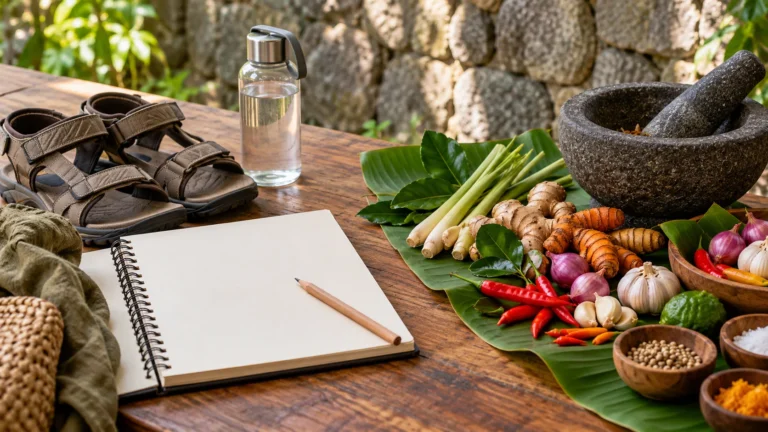
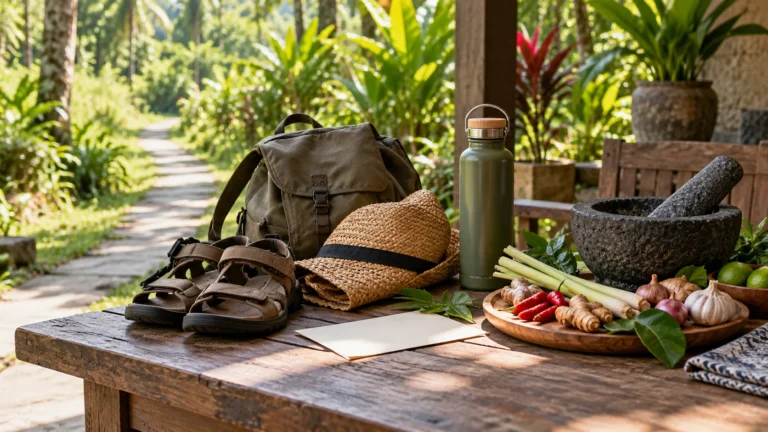
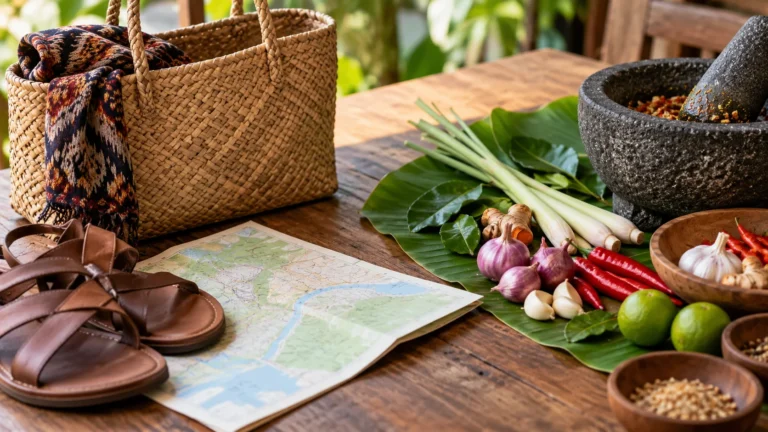
Planning an Ubud cooking class is easier when you decide what kind of morning you want before comparing prices. Do you want the context of a local market, a quieter cooking session, a private booking for your own group, or a flexible experience that fits around the rest of your itinerary? This Ubud cooking class guide explains the decisions that matter first, then points you to the detailed pages that can answer specialist questions.
Start with the experience, not the headline price
Putu’s direct experience takes place in a family compound in Pejeng Kangin, near Ubud. The class is private to the confirmed booking group, so a solo booking is possible and larger groups need availability and capacity confirmation. Someone visiting alone can use the dedicated guide to a cooking class in Ubud for solo travelers to compare private booking expectations with a genuinely shared class. Guests take part in the preparation of five Balinese dishes and eat the meal together. The exact selection can change with ingredients, season, and confirmed dietary needs; it should not be treated as a fixed menu promise.
There are two main formats. The market package normally starts early, with a typical pickup around 7:00am, and adds local ingredient context before the cooking and meal. The cooking-class-and-meal option skips the market and goes directly to the family compound. Choose the market format when seeing ingredients in their local setting is an important part of the trip. Choose cooking only when you already have morning plans, prefer a simpler schedule, or want to concentrate on preparation and conversation. The market tour cooking class page explains the package itself, while the Ubud market tour cooking class gives more detail about the visit.
Compare total inclusions before comparing prices
Prices change with the selected package and group size, so a headline number is not enough to compare two offers. Check whether the offer includes the activities you want, the meal, private guidance, and transport. Round-trip pickup from accommodation in Ubud is included; transport for a property outside Ubud is quoted separately after the exact location is known. Children aged 5-11 pay 50% of the applicable adult rate, and infants aged 0-4 are free. Optional alcohol is USD 3 per person when available and confirmed.
For the current figures and a fuller explanation of what changes the total, use cooking class in Ubud prices. That page retains the detailed price tables, while this planning guide helps you decide which questions to take there.
Know what the menu question really means
A hands-on class is not only a list of recipe names. You also want to know how ingredients are prepared, how aromatics are balanced, and how the group participates in each stage. The Ubud cooking class for beginners explains what that participation looks like when you rarely cook at home. The current format centers on five dishes, but the exact dishes may change when seasonal ingredients, availability, or dietary requirements call for an adjustment. Ask what is likely for your date and what can be adapted rather than asking for an unconditional fixed-menu promise.
The article on Balinese dishes cooking class Ubud explains how a suitable class menu works. The guide to Balinese spices cooking class is useful if you want to understand the aromatic foundation before you arrive. Together, these pages provide menu and technique depth without making this planning guide repeat every recipe or ingredient explanation.
Use the market choice to shape your day
A market visit suits travelers who want to connect the cooking with the ingredients and daily setting around it. It requires an earlier start and a larger time block, and it is most useful when that context is part of the experience you want. Cooking only is often the better fit for travelers with temple visits, spa appointments, hotel changes, or other fixed plans. It can also suit a group that would rather spend its available time at the cooking station.
Neither format is automatically better. The useful question is whether you want a broader cultural morning or a more focused and flexible cooking session. If your main constraint is the clock, compare morning vs afternoon cooking class Ubud for the scheduling tradeoff before selecting the package. The package page and market guide cover the detailed format; this Guide keeps the comparison at the decision level.
Keep detailed class-choice questions in one place
At the planning stage, consider the group you are bringing, the setting you prefer, the time you can reserve, and whether a market visit helps or complicates the day. A private family-compound format can offer personal pacing and room for questions, while a public social class may be a better fit for someone who specifically wants to meet other travelers. Putu’s direct bookings remain private to the confirmed booking group, so availability must be confirmed for the date and group you describe.
Once you have a preferred format, use the article how to choose cooking class Ubud for the operational questions to send before paying. This Guide should help you decide which questions matter; that article owns the deeper comparison process.
Plan for children and dietary disclosure early
Children can take part in supervised tasks when the format suits their age and attention span. The practical points are simple at this stage: share each child’s age, remember that the applicable rate differs for children aged 5-11 and infants aged 0-4, and keep adult supervision in place around hot pans, knives, flames, and other working areas. The cooking class Ubud with kids covers the fuller family-planning questions.
Dietary information should be sent before the booking is confirmed, not when pickup begins. Vegetarian preparation may be possible with advance notice, but a family kitchen cannot be presented as an allergen-free environment and zero cross-contact cannot be guaranteed. Explain every ingredient to avoid and the seriousness of the request. The dietary requirements cooking class Ubud gives the detailed disclosure guidance.
Separate cooking time from the total experience
The hands-on cooking portion at Putu’s home is approximately 1.5 hours. That is only one part of the day. Pickup, the drive, introductions, a market visit when selected, the family compound, the meal, photographs, traffic, and the return journey can all extend the schedule. Leave practical space around the class instead of placing another fixed activity immediately after an estimated finish.
The market package needs the largest block because it begins early and adds the market before cooking. The class-and-meal option is more flexible, but its total time still depends on traffic, group pace, and the time spent eating together. Use the how long cooking class Ubud when fitting the experience into a day plan.
Confirm pickup from the exact accommodation
Ubud round-trip pickup is included from the accommodation area covered by the booking. Properties described broadly as being in Ubud may actually be in a surrounding location, so the exact hotel or villa and a map pin matter. Outside-Ubud transport is quoted separately after the location is checked. Share the accommodation name, map link, and a reliable contact detail before final confirmation.
The guide on Ubud cooking class pickup explains meeting-point details and how to reduce delays. This Guide keeps only the boundary that affects the initial decision: where you are staying can affect whether included pickup applies and how much time the day requires.
A booking inquiry is not yet a confirmed class
A useful inquiry tells the host what you are considering; a confirmed reservation also establishes the exact package, date, participant count, pickup location, final charge, and payment arrangement. That difference matters when you are choosing between a market morning and a cooking-only session. A preferred time sent on WhatsApp is a request, not a held slot until the host confirms it.
If your plans depend on a boat, flight, another driver, or a child’s nap, mention the constraint in the first message. The host can then say whether the proposed session is realistic instead of giving a broad duration that sounds more precise than it is. Keep the written reply so both sides have the same plan on the day.
Move from broad planning to a confirmed booking
A useful first message can follow the same order as your planning: preferred date, selected package, number of adults, ages of children, exact accommodation, dietary requirements, spice preference, and any mobility question. Ask Putu to confirm the final total, pickup arrangement, package inclusions, and payment instructions in writing. Do not assume that a displayed package or an earlier conversation confirms availability until the date and details have been accepted.
For a confirmed direct booking, the cancellation terms state that 50% of the total payment is refunded and the remaining 50% is non-refundable. Review the Booking Terms with the final arrangement. If you want alcohol, mention it as an optional request because the USD 3 per person price applies only when it is available and confirmed.
Choose the format that fits the memory you want
The best choice is the one that matches your group and your day. Select the market package when ingredient context and an early cultural morning are central to the plan. Select cooking and meal when flexibility, focused participation, or a simpler schedule matters more. In either case, confirm the group, location, dietary information, timing, transport boundary, and final package before payment.
This Guide is the starting point for that sequence. Use it to understand the tradeoffs, then move to the relevant price, menu, market, family, dietary, duration, pickup, or booking page for the detail that affects your decision. That keeps the planning clear without making one article promise every package detail.